

The FarmED Podcast: Honeydale Farm Before FarmED with Jim and Wendy Pearse
Nov 04, 2026
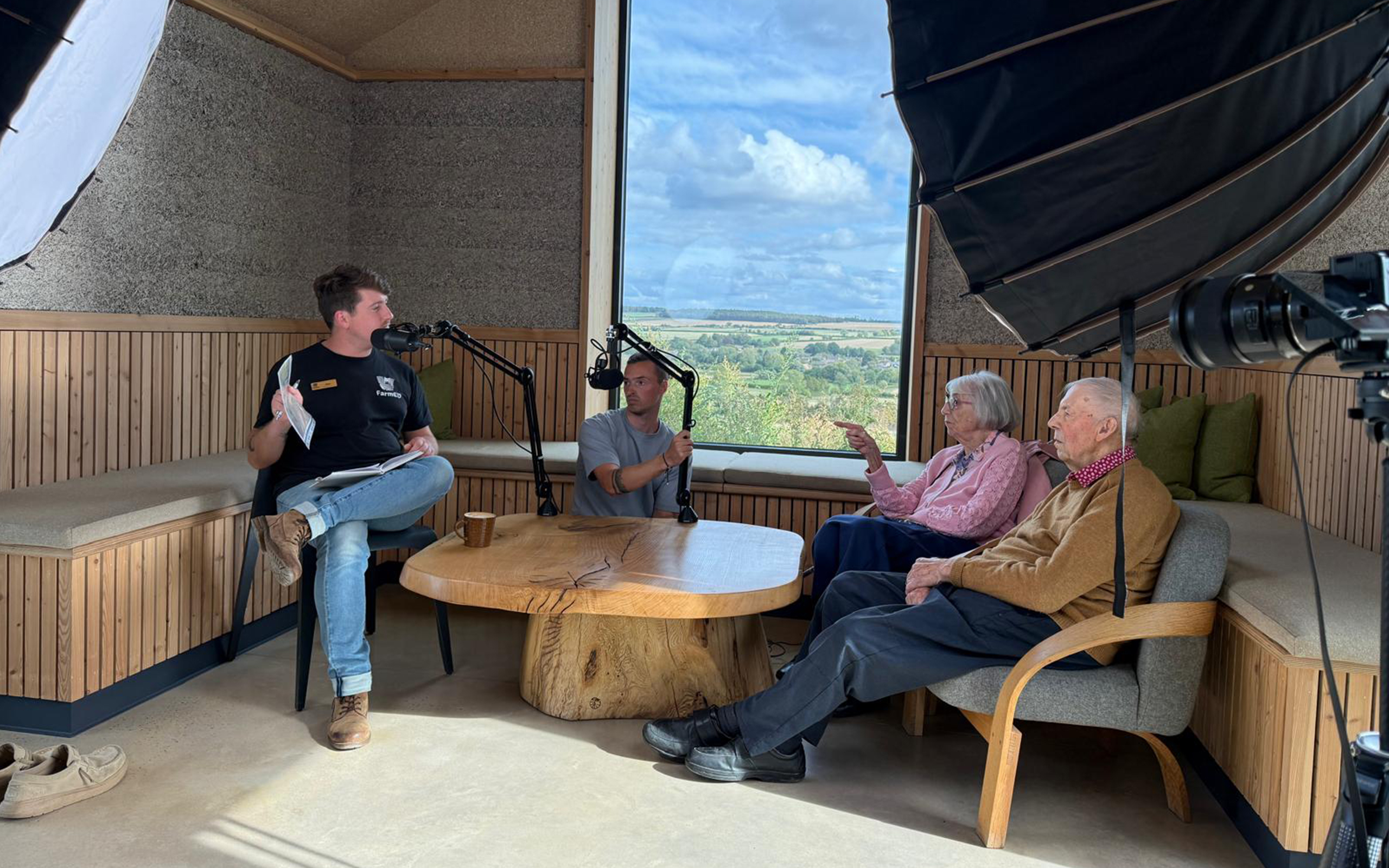
This month, Alex talks to Jim and Wendy Pearse who farmed Honeydale for many decades before Ian and Celene bought the farm in 2013. Jim’s family goes back 400 years in nearby Kingham, and were saddlers, blacksmiths and landowners and Jim and Wendy talk about the history of Honeydale and their memories, from being snowed in to weathering droughts and milking without power. They talk about the changes they’ve witnessed over the decades, including milk quotas and the ‘fashion’ for spraying. They remember the animals, from a small, tenacious calf nicknamed Keegan to their two Border terriers and share some of the joys of farming in the Cotswolds, seeing the cottages ‘glowing like gold’ in the seeing sun, and skylarks ‘singing their hearts out.’
Listen wherever you get your podcasts and watch on YouTube.
Full Transcript
Alex: Hello, good afternoon, good morning, good evening, whatever time it might be. I don't know why I started like this. Welcome to The FarmED Podcast. I am Alex Dye. I will be showing you around the farm today, but not only the farm, the history of the farm, because today's guests are farmers, the previous owners of Honeydale Farm, and firm, firm friends of FarmED. It's Jim and Wendy Pearse. How are you both? So let's launch straight into it then. So, how did you first come to farm here? How did you first arrive at Honeydale Farm?
1:00 How did you first arrive at Honeydale Farm?
Jim: Well, Honeydale Farm was part of the Coldstone Farm, which is based at the bottom end of Ascot near the Shipton end. And when my grandfather was a tenant, when he died, it was vacant possession on the 29th September, 1952. So that's when the landlord sold it. And it was sold in the various pieces. He had five or six different lots of the land and the farm that were sold separate. So my parents bought this, the block that is now Honeydale Farm. And they named it Honeydale because the largest field was named Honeydale. So, uh...
Alex: Was there any particular reason they went for this block here, this farm?
Jim: We didn't know quite how it was all going to work out, so my parents looked all round the near county and they couldn't find anything suitable at all really. I definitely wouldn't have gone, I wanted to go outside the view that we could see. And then it was really good fortune that this came available and they were able to buy it on a mortgage from the AMC.
Wendy: The best part of the farm, because they'd farmed it before, the land is Coldstone Farm, wasn't it? The best part of the farm.
Alex: And how long had your family been involved with this farm then? Or indeed, how long had they been involved with farming?
Jim: Well, the Pearse side of the family goes back 400 years in Kingham, and they were saddlers and blacksmiths and landowners and all sorts of things there. And then my mother's family were all farmers. Every uncle I had was a farmer, so it's all in the blood.
3.00 I'm finding a lot of black grass that I'd never seen here before.
The poultry manure we had to move on the road. Oh, yeah? Yeah, it was a sort of a deep litter poultry business over there. They had cockerels and laying hens, laying eggs for hatching. And they had quite a, not nasty stinking manure, but it did a lot of good. We had enough to do a field once a year for seven years, and the wheat grew faster and stronger, and it did make quite a good bit of difference. But then the agronomist was walking around, he said, I'm finding a lot of black grass that I'd never seen here before. And black grass started coming in, and it got bad enough to choke the wheat in some seasons. So we stopped doing that.
Alex: And was that brought around by the use of that chicken manure do you think?
Jim: Yeah. Not their fault I suppose. Then I started growing the four fields of barley. It did alright because there's only a good old one year crop that yielded. We mentioned 2011 and the malting price was sky high and made a good money on it but we nearly always got malting. Years ago we used to grow the old proctor barley and if you got proctor you could sell it for malting whatever state it was in. So then that all made a difference.
Wendy: That talk the other night about the soil. I thought that was quite something to think about. Well, somebody asked the question about whether he should put sewage on his land. He hadn't made up his mind, and the reason, why was questioning it, what’s in sewage today? Drugs micro-plastics, you don't know what you're actually putting on the land that eventually could grow, what people are going to eat. So it does make you think, you know, none of these things come without something affecting it in the future, do they?
6:00 When my father was doing it, he stuck to the old rule that you only had clover in once every five years.
Alex: And did they all farm similar things? Was it livestock farming mostly or did it vary?
Yeah, livestock and the grass fields, three grass fields and four arable fields. The arable fields, lighter soil, they were all corn crops. Then we had one field each year for the hay crop, clover and ryegrass. When my father was doing it, he stuck to the old rule that you only had clover in once every five years. And so that mixed it up a bit because you get two thirds of the field of clover and ryegrass, and then the rest was in another piece, which didn't do so well. By the time you'd been around all four fields, you've got eight pieces of land, instead of four. And then that made eight corners instead of four corners to work around with the implements. That made it more complicated.
Alex: So why would you do clover once every five years?
Jim: Because it got clover sick otherwise. The old fashioned Cotswold red clover. But red clover is a good thing to plant because it's got good long roots, like halfway up to being like parsnips, and that puts fertility into the ground as well.
Alex: Is that something that was done quite a lot back in the day?
Jim: Yeah, yeah. A lot of people around here, it was customary to have at that time sheep penned out in the field. They used to have turnips and sweets and kale and penned the sheep over it to put the fertility back in the soil.
Alex: So that's interesting because I'm sure that for many people who are listeners and followers of us at FarmED, this is quite a common practice now in regenerative farming, isn't it? To bring your livestock back into the crops, back into the land on an arable farm. But it was something that disappeared quite a bit, it was removed. Take them out and just focus on growing one thing quite a lot.
Wendy: Farming really became more modernized from when your dad did it, didn't it?Compared to sort of the1960s and 70s, it all started to change more, didn't it? From then on.
Yeah, and the other thing is the margins, profit margins on all the cattle and sheep really got narrower at times, and then the only thing they make out of them is the fertility they put in the ground.
8:30 How long did you farm here?
Alex: So it's almost like you're hoping for them to put that fertility in the ground, and if you get milk or wool or meat out of them, that's a bonus, rather than the other way around. Okay. So. How long did you farm here? Jim? And then, how long did you farm here, Wendy?
Jim: Oh, I was helping my parents and grandparents all the time they were here, really. So, I gradually came into it. And then, when mother and father bought the farm, they did it. You know, I more or less did what they told me to. And then when I found Wendy Scottish dancing in Witney, we had a good prance around there. And then we were married in October 1973.
Alex: Scottish dancing? Yeah. Do you want to give us a demonstration? We've got the cameras on. You say you did as you were told? Did you agree with the practices that were being done, or did you always have in the back of your mind, when this place is mine, I'm going to do things totally different?
Jim: It was always easy going but sometimes we argued about it a bit.
Wendy: Well, Jim's father was taken ill when you were in your 20s, wasn't he? And you did, he started doing it more then.
Jim: 1968, it was. Yeah, he had this heart trouble, and it was just at the same time that we had the hay barn built as well. He was in the hospital for six weeks, I think. And anyway, they gradually got him better over the time. It was amazing what he could do afterwards. When Wendy came and we were married, then they offered me the tenancy straight away. So I was the tenant farmer of their farm, sort of thing.
Alex: But they saw Wendy and thought, okay, she knows what she's doing, give these guys the farm now.
Wendy: She didn't know what she was doing, it was all totally new. I worked in an office in Oxford, but it was amazing. I spent hours and hours on the tractor after that for years, didn't I? Jim was still doing the milking when we were married. He'd been doing it since he could attempt it. And by the time he got to 50, he said, that's it, I'm finishing milking. But before then, I used to do the calves, didn't I? Of course, once we hadn't got the cows, we had to buy the calves in after that and rear them with store cattle. So it was a different job, wasn't it? But I was still on the tractor.
12:00 I’ve seen the old survey, 1600, it's called Honeydale Plat, or Place.
Alex: And what sort of jobs? Because I know that you've told us stories before about how much you love to see the plough, and particularly the story of why Honeydale is called Honeydale. That was to do with the soil, wasn't it?
Jim: Sticky yellow clay.
Alex: So it looked like honey?
Wendy: I’ve seen the old survey, 1600, it's called Honeydale Plat, or Place. And so when the enclosure came and they made it into the separate fields, that was the biggest area within that field. So they called it Honeydale Field then.
Jim: The other two grass fields. The middle one's Plum Tree for some unknown reason. And then the other one where the orchard is now, that was Withy Slade and it was called Withy Slade when it was an old furlong, back in the medieval times.
Wendy: You know. Probably further back than that from when they had the open fields. They had to have names for them all to know what they were talking about.
13:00 How did the farm change?
Alex: I’ve always thought if I could go back to when Ian and Celene were first sort of setting up shop here, getting things sorted. They missed a trick by not putting the orchard in the field that's called Plum Tree, didn't they really? I don't know why. They should have thought that one through. Anyway. So over the years, how did the farm change? What did it start off at? When it was first handed to you and you became the farmers here at Honeydale. What did it look like and what did it change into over the years?
Well. It was basically still the livestock on the grass fields and the corn crops and the top fields that are lighter soil. But I changed it to a four course rotation so that it went one crop in each field each year. So that made it a lot easier. But it still varied with the weather.
Wendy: I was going to say in the ridge and furrow that's still there, which is very rare nowadays.And that's because it was left as grass fields, but it shows that they did use it for arable all through the centuries. It's only below these fields that it well, there were some ridge and furrow just below at one time weren't they? But after that, it was all meadow. So it illustrates how it was used in the past.
Alex: And it was also, was it part of it ploughed up and used during the war efforts as well? Is that right?
Jim: Yeah, that Honeydale Field, they said it got to be ploughed up. But Dad always collected maintained it in the lands because, and I could see when we were cutting the corn with a binder. That when it was a dry time, the crop looked level. It wasn't doing much on the ridges, but down in the furrows that was growing really good and strong. And then in the wet times, it was all growing strong on the ridges, and you really got dips down with nothing in the furrows. I think the old people weren't silly, they knew if they did it like that they'd always have some harvest. You would never fail a harvest because it would always be on either one or the other, if not both.
16:00 Did you start to change things up a little bit, try anything different?
Alex: So, what happened as time went on? Did you start to change things up a little bit, try anything different?
Jim: Well Yeah. There was the root crops we used to grow some couple of acres of kale and mangles. And there was a lot of work to mangles. I enjoyed doing it. To say, well, before we were married, I said to Wendy, I've been pulling and drawing today. I said, I've been hung, drawn and quartered. It was pulling mangles and then drawing them into a clamp, you know. On the trailer. And now the course it had to all be covered up to keep the frost out, which was quite a big job as well. But then I got the idea, or somebody told me, or something, there was sugar beet pulp you could get in sacks delivered to the north, and so we changed to that instead. And that saved a lot of time and a lot of work as well really. So we got more cows and then as time went on I got, I decided well I've been milking these cows for 35 years, by hand for quite a while because there was no electricity, no phone, no nothing up here when we came, it was just the fields and then we in 1961 on we had a diesel generator. A second hand one that was going spare somewhere. And we installed that and then I could have a milking machine with a couple of units and that made it better. But we used to take the milk churns. A couple of churns each day up to the main road to load up. And at that time. I'd only got this old Morris 8 and that was my grandmother's and it was our car, you know. Put the churns in there. And he used to drive out onto the road and reverse up just to the top side where our gateway was and unload them and then come back down. If you tried that now you'd be mincemeat before very long. Such a lot more traffic.
18:40 If someone said the words regenerative agriculture to you, would that mean anything at all?
Alex: And at this point, I mean, just going from my awareness of farming as someone who's not a farmer, if someone had, let's say in the 1970s sometime, said the words regenerative agriculture to you, would that mean anything at all?
Jim: Not a lot, you'd have to think about it.
Wendy: Well. And that was the time when they started to bring in a lot of spraying, and that was a different system from then on. I mean, they used to, some of the fields around here. They used to spray so many times I mean, we didn't unless it was absolutely necessary. But they did didn't they? It was just all the fashion in a way. And then it began to slowly change back into what the old ideas were.
Jim: It did a bit of harm, really, I think, because before the sprays come, there used to be a patch of mint in the far bottom corner of Honeydale Field. And when you cut this corn with a binder. That got such a sweet smell. And once it was sprayed. You never smelt that again. The other thing. It was a beautiful little flower. We called it Heartsease. It was sort of like a wild pansy. Really pretty flower. As big as your thumbnail. I suppose it's what they got the other modern pansies out of. But anyway things like that were lost. There was a lot of cult seals as well. Which was a good thing because they had massive, great leaves on them. When you cut the corn with a binder and it was all tied up in sheaves, the bottom end, the straw was all full of this green stuff. So, unless you got a really clean field. It took a while to dry before you could build it into a rick.
20:40 What drove the decision to sell the farm?
Alex Dye: As you came up into the sort of the 2000s, the millennium, and approaching the sort of time where you were getting ready to think about selling the farm and moving on to pastures new, do you mind if I ask what drove that decision? Is that okay?
Wendy: Well, basically. It was me because we were isolated down here. And I used to think about what would happen to me if anything happened to Jim I was just left here and not only that I mean you'd had your problems with your knees it was getting tougher to do the work, it really was necessary wasn't it by that time? We had to move.
Jim: Some years we got snowed in, well, especially in 1963 when that, well. Wendy wasn't here then, but that drifted, the fields were all swept clean of snow and it was up to the shoulder high, up to the top of the wall. And they said, well, it'll soon go, I expect, you know. But it didn't go. And there were no JCBs at that day, so we had to dig that out with the shovels and chuck the great big lumps over the wall and took us a month to get to the top. But before that, we, you know, for the groceries and everything. We had to run up the field with the tractor and the trailer and leave the trailer at the top. And when the grocery man came he put the groceries or anything else that we were having, bread, and you’d go later and and bring it back down.
Wendy: But it kept snowing for a lot of years. Yeah. And the last year it really snowed was when we finished milking. Wasn't it? And we'd had four years with three years of those being cut off for three weeks up the road. So it really was. And then after that, it never came on again, did it? From then on we didn't really have hardly any length. No. Time length of snow, did we?
Jim: Well, the other thing was, instead of milk in churns they made everybody go in the bulk tank. Then the bulk tank lorry had to come down. So he had to, you know, when he couldn't get down there. We had to put the put the mobile tank on and move the milk out to the one end of the area, put it into the other one. And they used to come at quarter past seven in the morning. And I'd ridden on the tractor tractor trailer with a bulk tank on and left it there and come back down. I was blimmin' cold.
23:00 There was a fairish drought.
Wendy: It was hard work, wasn't it? Yeah. One year, when everything froze, didn't it? All the water. Water.
Jim: And I got to 50, I sort of had enough to do with milk, and so, We sold the cows and bought a lot of cattle. Too many cattle. Somebody advised us that you can have a lot of cattle and replace the cows. And then that was a wretched year in 1990, I think it was. There was a fairish drought. I don't know if it was a desperate drought that we've had this time, but it was enough to stop the grass growing so fast. And there was hardly any grass down there in these fields. And up on the top field nearest the north field of the four that we got down for hay that year, and it reduced the yield in there by two thirds.
Alex: Two thirds?
Jim: So these cattle that we bought. The year before, it was desperate, you know. We took them to market and they were only a pound or two more than what they were when we bought them the year before. And then we went to Bicester Market, somebody said, that's good. And it was chock a block with cattle. And it was pitiful to see them going for next to nothing, you know. And then, well, then it went through the floor when the price was all you could get for.
Alex: Did that start to happen more and more frequently then?
Jim: No, it was that one time really. We got so many cattle and it was the bad time, and otherwise, well, we had a lot less after that.
Alex: And did these weather conditions, so you mentioned the snow, were there lots of weather events over the years? It sounds like some of these things were reasonably spread apart in terms of these droughts you mentioned in the 90s and uh, this snow events.
26:00 A couple of years before we sold the farm, we had a really good year
Wendy: What was that the same year that the arable didn't do any good? And someone who lived across the valley used to do the combining for us, oh, yeah. And it was just sheer luck. He said, what was there? He said, I'll buy it and use it for my cattle. So we didn't really sell anything for any, you know, because you could sell barley for malting for a good price, and it was just hopeless that year, yeah. That was 1976, I think. But as you say, it must have been nearly the same in 1990.
Wendy: I don't think you ever made much money, Alex. It was always something, wasn't it?
Jim: Yeah, well, a couple of years before we sold the farm, we had a really good year, and the barley all that grew really well. It's the best yield we've had by far. And then most years we had these malted varieties. And this particular year it was worth £200 a tonne, which was a good £50 a tonne more than a feed. And so that came to a lot of money, and we had a good yield and everything, and we had a bit of cash in hand then. Is this about 2009, 2010 ish?
Wendy: No, it would have been about 11?
Alex: And so, were there quite a few of these years where, let's say if you had it, because you mentioned there were some years where it was very, very hard to make some money from it. And were there several times where, or were there times where you sort of thought, I don't know if we can keep doing this?
Wendy: He’s actually born a farmer and he hasn't given up now, not in his attitude.
Jim: People say, when are you going to retire? And I said, that's an evil day to be put off as long as possible. So we put it off till I was 75.
Wendy: You’re lucky Ian bought the farm and come up whenever you want to. So fortunate. We never expected that, did we?
Alex: So, how did that come about then? So, you decided you were ready to move on from the farm. Maybe it was an evil day, like you said, but you decided to sell the farm, and then what happened next?
Wendy: Well, you had it up for auction, didn't you? What they advised.
Jim: Yeah, well, a lot of people came and viewed it. It was amazing. They came out from London with their bank managers and their advisors, and as well as local people. And they all went, oh a beautiful spot, you know. And then when it got to the auction, it seemed as though there was only one or two other farmers bidding and Ian.
Alex: Were there any other potential buyers other people who were at this auction or had come to visit the farm who you sort of thought, this farm would be in good hands if I left it to this person? Or were there people who you perhaps thought, I'm not sure about these guys? I'm not asking you to sort of speak ill of anyone of course.
Jim: No, there was only well, I call her a girl, she was a very young woman with horses, from Swinbrook and she said, would you sell it to me for half a million? I said, no, I can't do that.
Wendy: She was keen to have it, wasn't she? But she didn't want the farm, she wanted somewhere for the horses, and hopefully somebody else would look after the fields. But I don't remember there was anybody. There was somebody whose land was going to be taken up with the new railroad? Oh, yeah, and he came, didn't he? But Ian was practically one of the first, and that was in June, yeah, so it was a lot of time to wait before the sale.
30:00 So the hammer fell…
Jim: Yeah, he said, This, I'll bring a spade and you know, see what the stones are like in the soil and that sort of thing.
Alex: So the hammer fell? He had bought the farm, did he tell you what his plans were for the farm? He and Celene did they tell you what the plans were and what did you think of those plans?
Jim: He said to grow seed crops. Yeah, that's all right. He didn't at that time mention all about the soil fertility which is doing so much good. Good.
Wendy: We never really knew what he wanted to do, did we? No. But I mean, as it gradually grew, you kept coming up here didn't you? And he gradually told you then what they were doing. Yeah. Didn't he?
Jim: Yeah, I was going round here every week on my own. Before he had started, got the plans all sorted out and what he was going to do with it, you know. It was amazing to see it all taking shape and all being done in such a good, everything up to such a high standard. I was quite impressed. Yeah.
Alex: Looking back over everything that's changed over the past 10 years or so that Ian and Celine have turned this into FarmED, do you think, is there anything you think, oh, they should have done that differently? I wouldn't have done that.
Wendy: There’s just one thing. That I was a bit sad about. Because as you come from Chippy, the first field you come to…you have the view. Well, when Ian first planted the trees at the top of the other three fields, it didn't matter. But when he started planting them along that one, I was a bit sad because it meant nobody could suddenly see the view.
Alex: This is the shelter belt.
Wendy: Yeah. That's about all. Yeah. Yeah. Can't think of anything else.
Alex: That’s fair enough. I mean, I think there is something quite nice about, you are absolutely right that when you come through that hedgerow, when you come into the farm and you see the valley, as people who are watching on video can see behind us now, it's a very, it's a really picturesque part of the country.
32:45 What do you think about some of the challenges that farmers are facing today?
Wendy: You come all the way along that road and you can't see what's there. And suddenly you got to that field and you could see that there was a valley which I always used to think was so nice.
Alex: And is there anything that you think, so obviously we talk a lot here about the challenges that farmers are facing going forwards, things that have changed a lot over the years, what do you think about some of the challenges that farmers are facing today? Are they the same challenges they've always faced for years and years or from your perspective are there new things coming about all the time for people to think about.
Wendy: Well, I think that with Jim and his family, it went back centuries that a farm was where you lived. It was a life on a farm. And now farming has become a business. It's the only way they can survive, which is quite sad, really, that, you know, they can't just live the life that they want to, tending to the land. They've got so much to abide by now.
Jim: When I was getting the cows in, I used to have to get them in early. You know, you could see all the lights on in the dairies all around the hillside over there. And everybody was out milking their cows. And now there's hardly a cow in Oxfordshire.
Alex: Yeah, there's not many cows or dairies at all in the area. But do you think this is something that has. Was it quite a gradual change or did it seem to happen all of a sudden?
Jim: It seemed to happen quite quickly, really.
Wendy: No, in a way it was a gradual one because then they brought in the milk quotas, didn't they? And that was sort of the beginning of where people thought, well, is it worth it? We we were quite fortunate there because we were there when they brought in the milk quota, and they didn't take it off the farm when you stopped milking, so it was a bit of an income to us to be able to sell it to somebody who hadn't got enough. Gradually got less and less, didn't they, round here?
Jim: Yeah, better than being able to sell it, you could lease it as well. So you leased it out to somebody and it was incredible what they paid for. There was only about 13 pence a litre on the price and they were prepared to lease it into their farm for 12 pence a litre So we were having the money and they were doing the milking.
35:00 It was a wretched TT, tuberculosis problem.
Wendy: Mine was never that much because we hadn't got that much of a quota had we? But it did make a difference. But that seemed to be the start, then you gradually heard, ‘Well, so and so's stopping milking', didn't you? And it just took off, everybody round about. I mean, lately, the only one we know of that did milking was Robert, who lives at Bledington, and he's given up now. So, you know, do you think there were all these people doing milking?
Jim: It was a wretched TT, tuberculosis problem. Because when we first came up here, we had a tuberculosis test, and they were all clear, and we never ever had a cow reacted and had to be slaughtered on the farm all that time. And yet there were badgers in the hedge and they were always there. So, but what did change around this area, a lot more deer came around, and the fields were, you know, they were going running about and grazing in the fields all the time. So, whether that, you know, that's another one.
Wendy: Because it did get to be an awkward time for farmers, though, because just before 2000, it was the foot and mouth, wasn't it which made restrictions? And then the BSE, and that was when we got as many cattle as we'd had. And you couldn't sell them, could you? We had to keep them all.
Jim: You had to keep them. I had to go around the hedge where I'd laid it, where the barbed wire, and keep putting barbed wire along the top in places because they eat all the green grass, then reached over, eating the grass on the man's fields.
Wendy: So that might be another reason why it got less and less cattle about.
Jim: Because it was. Yeah, that's a big drawback when you've got those sort of things going on.
38:00 What would you like to see more of in farming?
Alex: So, what do you think, if there's anything that you think modern farmers, modern farming in the UK could do with more of, what do you think that might be? What would you like to see more of in farming?
Jim: More people interested in food. I mean, yeah, they don't realize that you have to have food to live. If it doesn't come from this country, it's going to come in from somewhere else, and eventually the price of the imported food will go up a lot more, I think, one way or another, with the state of the world.
Wendy: It’s all right doing the rewilding in land that isn't suited for farming, but it does seem a shame to take good agricultural land out of food production. I think I think people that live in the cities and that they don’t, they’re just not aware of what it really means. Nice to go out in the countryside. What it really means. Nice to go out in the country and go somewhere where they can just enjoy themselves out in the country as they think, but they're not thinking about who's going to feed them.
Alex: Yeah, everything needs to be in balance. There needs to still be food produced for a growing population and spaces for wildlife and nature to prosper as well. So, what about all the joys of farming then? What about all the good days? What were the best things, the best memories of farming here over the past 50 odd years?
Jim: Oh, so many good. I was lucky straight away, really, because my parents built a four bedroom house, and my bedroom faced down to what you could see from this window, all across the valley, down over the inland, and up the other side.
Wendy: Remember when we had the bungalow built? We had the view again, so every morning you could wake up with the view. You could see the sun rising over Wychwood Forest, and you could see the sun in the evening catching all the stone houses down in the village, growing like gold, couldn't you?
Jim: Yeah, when it got towards the shortest day, the sun was right round behind the bottom of the trees in the forest, and you could see the individual trunks as the sun moved round, as it got the days got shorter, and they got another one or two trunks further on. It was quite interesting, really.
Alex: What about on the farm? The life on the farm. You were talking earlier about wildlife, birds and animals and all sorts of things like that.
Wendy: Well, I mean, it was the joy of seeing a calf being born, wasn't it? Tottering about and then suddenly they were stood up on their long legs, managing to look as though they were pleased to see the world.
Jim: Yeah, nothing quite so. You know, you could see the delight of the calf when it started sucking, filling this empty stomach with the colostrum and wagging its tail as hard as it could go. It was delight, really. And all the calves being born, you know, it's good to have another life on the farm.
41:00 You had one you called Keegan, didn't you?
Wendy: You had one you called Keegan, didn't you? Because he was a little black Angus, and it was a heifer. And she just wouldn't have anything to do with him. And Jim couldn't get hardly near her because she kept kicking. And this little calf, he just kept persisting. She kicked him back, did it again, kicked him back. And in the end, we said he was like Kevin Keegan because he always used to get knocked down and he still kept running towards the goal.
Jim: Yeah, yeah, so he was almost known as Keegan.
Wendy: Yeah, we had another little calf that we had after we'd stopped milking and we bought a batch of calves in. And amongst this batch, they all grew except one, and he just didn't grow at all, did he? And so we used to keep them in the barn in the pens through the winter. And then when the spring came, the joy of these calves when they went out onto the grass, kicking up their heels and their tails stuck straight up in the air. But we couldn't let him out because he was too small. So you kept him in a few more weeks, didn't you? And eventually decided he'd better go out and to see the calves running down the field as fast as they could and in trundling along on his little legs behind him. So eventually we kept him a year longer because he gradually grew and he was one of the biggest animals we ever had. He was always calm and friendly. He turned out really well. We called him Hereward. He was like Herward the Wake, he was a survivor. But I mean, the pleasures of the birds. When I first came here, the lapwings used to land in the field up above the bungalow, didn't they? And then you used to get lots of skylarks going up, singing their little hearts out. And then we used to have the swallows that used to nest in the cow shed. They came back every year, and you could see all the little heads peeping over the edge of the nest. And then when they fledged, for some reason a lot more joined them, and they used to sit all along the telephone wires between the buildings, didn't they? Yeah, just before they all flew away to go back south, you know, they they all lined up on, so forty, fifty, all lined up on the wires, and you know, really, really pleasing to see them,
Wendy: And then we had our two border terriers, who absolutely loved it here.The first one, he was a big animal, long legged, and I always said he never stopped running until he was 12. He was just full of energy, wasn't he? And he used to take off down the fields and he always had to be with us. Whatever we were doing, his nose was there. He used to love riding on the tractor and on the trailer, didn't he? And on the occasions when we couldn't let him be with us, he was quite happy to sit in the car. As long as he was in the car, he was all right. But the second one, she was only half his size. I don't think she was…she liked to be here and she was just stand and bark at the top of the steps to the bungalow, as much as to say, ‘This is mine.’ But she was very clingy. And you couldn't leave her like you could Tiger, could you? Rosie.
Jim: When you used to take her and walk, ‘where's Rosie? Where's Rosie?’ because she couldn't see her. No, she was down behind her. So close behind her heel, she couldn't see her. As close as she could get.
Wendy: She didn't expend any energy. She didn't need to. But she was a real delight, really, because she had to be with you, didn't she? We couldn't really except for leaving her with my parents. We couldn't leave her, could we? We always had to have her wherever we went. But I mean also the other pleasures were seeing the landscape. I mean, I remember one year when the snow was all over everywhere and the little crystals in the top of the snow froze and they were all shining in the colours of the rainbows all over the field. Yeah, like diamonds. Yeah. And another year, and I only ever saw it once, and I don't know what type of grass it was, but in that big meadow where we used to make the hay. One type of grass grew up and it had flowers. That were of lilac color, and the whole field shone in lilac, didn't it? I don't remember ever seeing it more than once. It must have been a really good year for that particular type of grass.
Jim: They seemed to dominate all the other grasses and took over, so it was all the same color. But I did notice afterwards a bit of that scattered about here and there, but you know, there were all the others as well. It used to grow some really nice hay. One engineer chap come to the tractor up here one time by the barn where the bales were in the barn. He said, ‘You ought to charge people for coming here. That hay smells so nice. You could go in the barn in the middle of winter and it smelled like summer. It was a real pleasure, wasn't it, when you could get some really good hay. Yeah. Yeah.
Alex: It sounds like a wonderful time, and thank you so much for sharing your wonderful memories of your time on the farm with us here today. And thank you to you for joining us for another episode of The FarmED Podcast. And we'll see you again next time. Drop us a like or a review if you want to. But we'll see you again soon. Thank you. And thank you. Thank you.
Recent news items